What we do
Every organization has a filing cabinet full of how things should work and a corridor full of people who figured out how they actually do. The filing cabinet gets updated when there’s a project. The corridor updates itself every Monday morning. We work in the corridor.
We map this, measure it, and put it to work:
 #1
#1Process documentation
We map how your organization really operates. Like really, really. Including the uncomfortable, contentious parts that most documentation skips.
 #2
#2Technology adoption
We measure your team's individual capacity to absorb new tools, and tailor the introduction to each team's specific needs. Why? Because it's the only way that works.
 #3
#3Operations context for AI
We distill the true workings of your organization into a format that matches how AI reads. Without it, your LLM is a brilliant stranger: articulate and capable, but guessing.
Measuring reality
Industrial sociology
How we see what the last consultant missed
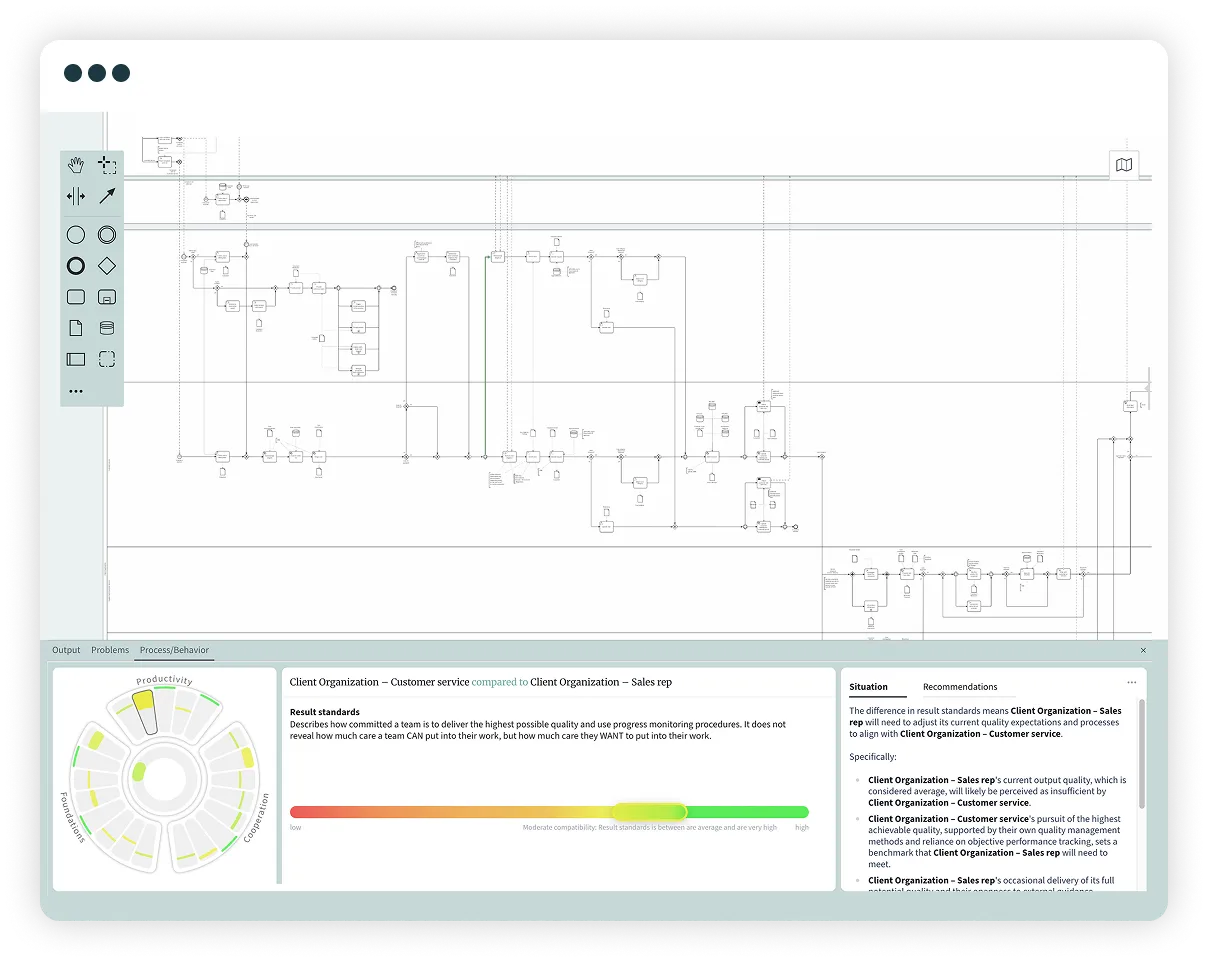
All three rest on the same foundation: as we map a process or measure adoption readiness, we also inspect how the teams involved actually function – using validated, peer-reviewed instruments from industrial sociology and organizational psychology.
The easy entry: Behavioral risk to capital
The measurement itself needs no large-scale project around it. So we also offer it on its own, for the four most expensive behavioral risks to capital. Your supply chain is monitored: thresholds, alarms, a mitigation plan. So are your IT systems. Your teams are not. Because these four risks are about people, everyone has a feeling and nobody has hard numbers. And certainly nobody has interventions.
No big commitment, four weeks at most, and you will see your own organization differently.
The four most expensive behavioral risks to capital in detail.
Read moreThis tells us what a workshop alone cannot: Which teams are under enough cognitive strain to prefer giving you the short version in a mapping session? Which have low enough vertical trust to recite the official process instead of sharing the real one? Which will nod through a rollout and quietly revert within weeks?
Where culture and systems disagree, mapping a process needs more care than it normally gets.
Scale of engagement
Our engagements are measured in months, not weeks, and scoped to the organization in front of us. A single-team engagement looks different from one spanning twenty countries; we have done both. Pricing reflects that range.